One of the biggest challenges in bringing AI to motorsports hasn’t been the technology itself—it’s been challenging the deeply ingrained mentality of “how it’s always been done.”
Many foundational data analysis texts in our industry are more than a decade old, and most analysis software still defaults to the same channels and visualizations that engineers relied on years ago. But the landscape has shifted dramatically. The number and types of sensors on modern race vehicles have evolved rapidly, generating data that can unlock insights we could only dream of a decade ago.
Here’s the reality: no single race engineer can wrap their head around the hundreds of channels available on a modern race vehicle. And even if they could, they don’t have the luxury of unlimited time to do so.
The scale of the problem is staggering. I’ve spoken with teams running over 2,400 data channels sampling at 500Hz. On a 100-second lap, that’s more than 100 million data points—nearly a gigabyte of raw information. Even the venerable Excel will choke on that volume after just a few laps.
What the industry needs isn’t incremental improvement. It needs new tools and fundamentally new ways of thinking about how to leverage all that data for a competitive edge.
The Current Reality
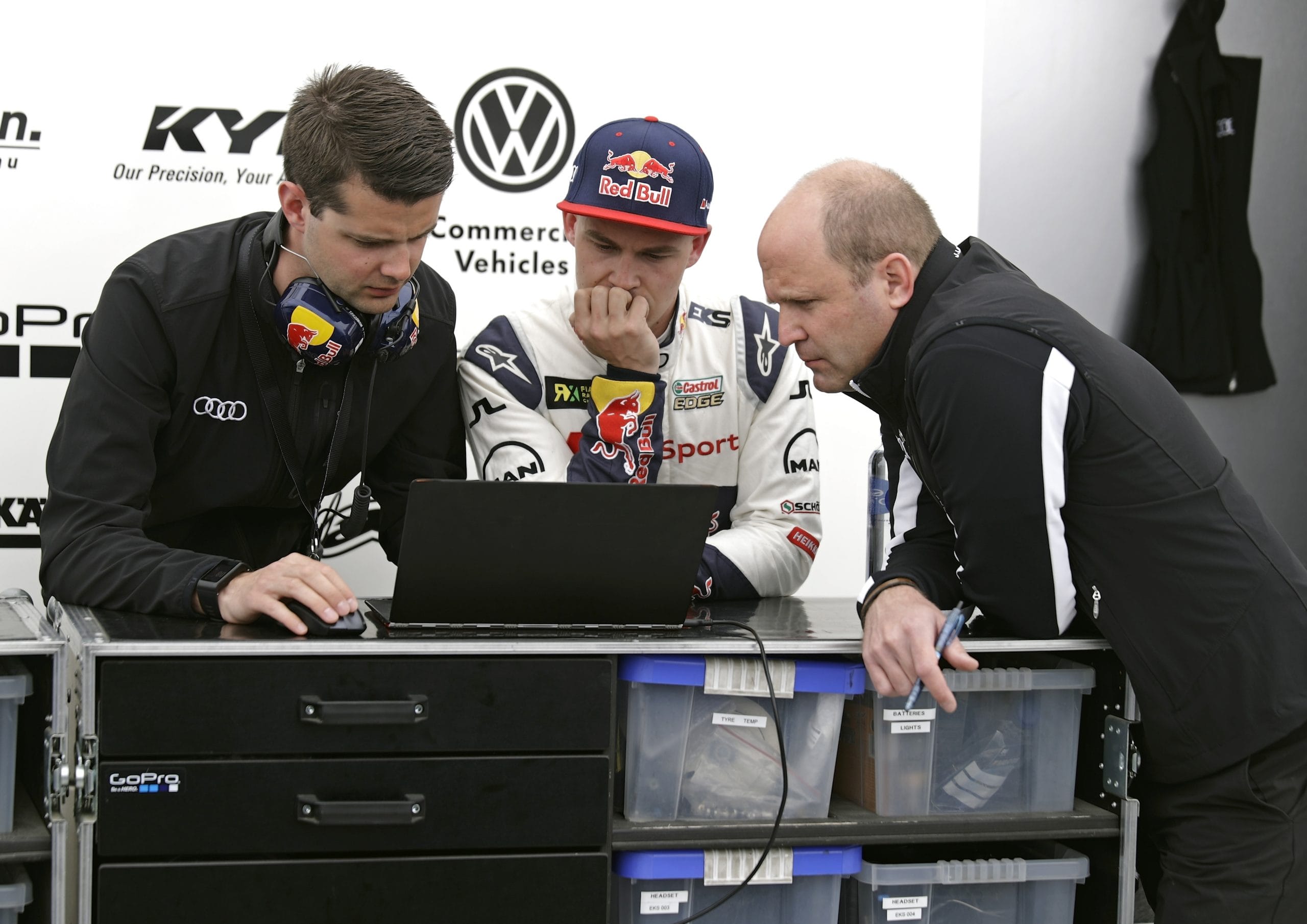
Walk into any race engineering debrief and you’ll see a familiar scene. Engineers hunched over laptops, toggling between the same handful of trusted channels: speed, throttle position, brake pressure, acceleration channels, maybe some suspension travel. They’re not ignoring the other data out of laziness—they’re making pragmatic choices under impossible time constraints.
Between sessions, an engineer might have 45 minutes to download data, debrief with the driver, identify setup changes, and communicate with the crew. There’s simply no time to explore channel 847 to see if it correlates with that weird understeer the driver mentioned in Turn 6. So they rely on intuition, experience, and the same dozen visualizations they’ve used for years.
The tools don’t help. Most analysis software requires engineers to manually select which channels to compare, define their own thresholds for what looks “off,” and visually scan through lap after lap hunting for anomalies. It’s like searching for a needle in a haystack—except the haystack is a gigabyte and you have half an hour.
The result? Valuable insights hiding in plain sight. That subtle vibration signature preceding a component failure. The tire degradation pattern that only shows up when you cross-reference three channels nobody thought to look at together. The setup correlation that could have been worth two tenths a lap.
The data holds the answers. The problem is that no human—no matter how talented—can ask all the right questions fast enough and find the answers when they need them most.
Where This Leads
The immediate impact is speed—not on track, but in the paddock. When AI handles the heavy lifting of sifting through thousands of channels, engineers get their time back. Instead of hunting for anomalies, they’re evaluating them. Instead of wondering what they might have missed, they’re acting on insights they never would have found.
But the real transformation runs deeper.
Imagine a smaller privateer team suddenly having access to the same analytical depth as a factory-backed operation. Not because they hired ten more engineers, but because their existing team is now augmented by a system that never gets tired, never forgets to check a channel, and never runs out of time before the next session.
Imagine catching a developing mechanical issue three sessions before it becomes a DNF. Or discovering that a particular setup change consistently unlocks pace in a specific corner type across different circuits—a pattern invisible in any single race weekend but obvious when the AI connects the dots across an entire season.
Imagine the engineer-driver debrief evolving from “let’s look at the usual suspects” to “here are the five things worth discussing, ranked by potential impact.”
This isn’t about replacing the expertise that race engineers have spent careers developing. It’s about amplifying it. The intuition still matters. The experience still matters. But now there’s a tool that can keep pace with the data—so the humans can focus on what humans do best: making decisions, crafting strategy, and finding the edge that wins races.
The teams that embrace this shift won’t just work faster. They’ll see more, understand more, and ultimately—win more.
That’s exactly where Zaggy AI and the RAiCE system come in.
Every lap. Every session. Every time.